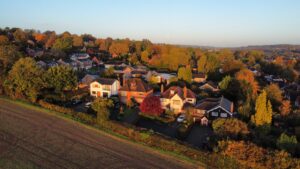
Gilston is one of the largest planned housing developments in Hertfordshire and will play a major role in shaping the future of the Stort Valley.
The planning position is important to understand clearly. East Herts Council granted outline permission on 9 January 2025 for 10,000 homes in the Gilston area – 8,500 homes across Villages 1 – 6 and another 1,500 homes in Village 7.
In August 2026, the project reached another major milestone when the detailed masterplan for Village 1, containing up to 1,600 homes, was approved.
For homeowners, the obvious question is what this could mean for property values. The answer will depend on location, property type, proximity to construction and how the wider infrastructure is delivered.
Understanding the Gilston Garden Town masterplan
Gilston forms part of the wider Harlow and Gilston Garden Town and is expected to develop over more than two decades.
The outline permissions cover seven villages alongside schools, healthcare, shops, employment space, parks, sports facilities and other community infrastructure.
The Village 1 master plan approved in August 2026 provides the framework for up to 1,600 homes, two schools, early-years provision, a village centre, commercial space, specialist accommodation for older residents and a one-hectare village park.
Walking, cycling and sustainable transport links will also connect the new settlement with Harlow and nearby destinations.
This means August 2026 was an important delivery milestone, not approval of the entire 8,500-home scheme.
The wider Hertfordshire planning picture
Gilston is only one part of Hertfordshire’s wider development story.
Welwyn Hatfield Borough Council is currently preparing a new Local Plan to 2043. Its Regulation 18 consultation ran from February to March 2026, but the plan has not yet been submitted for examination.
One proposal within the emerging plan is the Welwyn Hatfield Green Corridor between Welwyn Garden City and Hatfield.
The draft policy aims to improve green infrastructure and help maintain separation between the two urban areas.
However, it should not be viewed as a guarantee that every nearby site will remain undeveloped. Development may still be considered where it meets planning requirements.
For homeowners, this highlights why current planning policy should be considered alongside local property evidence rather than treated as a guarantee of future value.
What does the current property market show?
There is no simple rule that says a large new development will automatically increase or reduce nearby property values.
Current ONS data shows the average house price in East Hertfordshire was £461,000 in June 2026, up 4.0% year-on-year.
Detached properties averaged £892,000, semi-detached homes £530,000, terraces £418,000 and flats or maisonettes £253,000.
These figures show annual growth across the district but do not prove that Gilston is responsible.
Elsewhere in Hertfordshire, markets are moving differently. In AL8, HM Land Registry-derived data shows an average sold price of £554,042, around 3% lower than the previous year.
That variation is why sellers should rely on local comparable sales rather than broad county-wide trends.
Why infrastructure still matters
New infrastructure can influence how buyers view an area, but its effect on individual house prices cannot be guaranteed.
Gilston’s plans include new schools, community facilities, green spaces and walking, cycling and sustainable transport connections.
Some nearby areas may benefit from improved access and amenities over time, while properties closest to major construction or new roads may experience different effects.
The development will also be delivered in stages over many years, so its impact will vary by location and timing.
What should Hertfordshire sellers do now?
For sellers, the most useful approach is to understand how current conditions apply to the individual property.
A home in Gilston village will sit in a very different position from one in Bishop’s Stortford, Sawbridgeworth, Ware, Hertford or Welwyn Garden City.
Recent sales of similar properties, competing listings, current buyer interest and nearby planning activity provide a stronger basis for valuation than a single headline about new housing.
East Hertfordshire’s annual price growth provides useful context, but local markets can behave very differently.
Timing your sale in 2026
There is no authoritative evidence supporting a specific forecast that Hertfordshire transactions will rise by 4–6% in Q4 2026.
That does not mean autumn cannot be a productive period for sellers.
Mortgage affordability, asking-price strategy, buyer confidence, stock levels and property presentation will all influence activity.
Planning clarity may also help buyers understand how an area will change, but there is no evidence that buyers are returning to the market specifically because of Gilston’s latest approvals.
For anyone considering a move, a current valuation and assessment of competing properties is a more reliable starting point.
What Gilston could mean for different locations
The effect of Gilston is likely to vary significantly across Hertfordshire.
Properties closest to the development may be more directly influenced by construction, road changes and new infrastructure.
Homes further away may experience little direct impact.
Because the development will progress over more than 20 years, the market will respond gradually rather than to one single event.
That makes postcode-specific and street-level analysis particularly important.
Your next step with Country Properties
Gilston is one of the major long-term development programmes shaping this part of Hertfordshire.
The outline permissions for 10,000 homes were issued in January 2025, while the Village 1 masterplan was approved in August 2026.
For sellers, however, the impact remains local and property-specific.
Current evidence shows East Hertfordshire prices rising annually, but that does not guarantee that every nearby property will increase in value.
The most reliable approach is to combine current sold-price evidence with detailed knowledge of the property’s location, condition, competition and nearby development.
Country Properties can help homeowners understand how these factors apply to their individual property.
Book a free, no-obligation valuation with Country Properties to find out what your home could be worth in the current market and how nearby development may form part of the wider picture.
If you are considering selling in 2026, contact your local Country Properties branch to arrange a valuation and discuss the current market in your area.